
What Stations Chaplains Cross
On inter-religious negotiation, inter-faith risk, and the fervent prayer that availeth much.
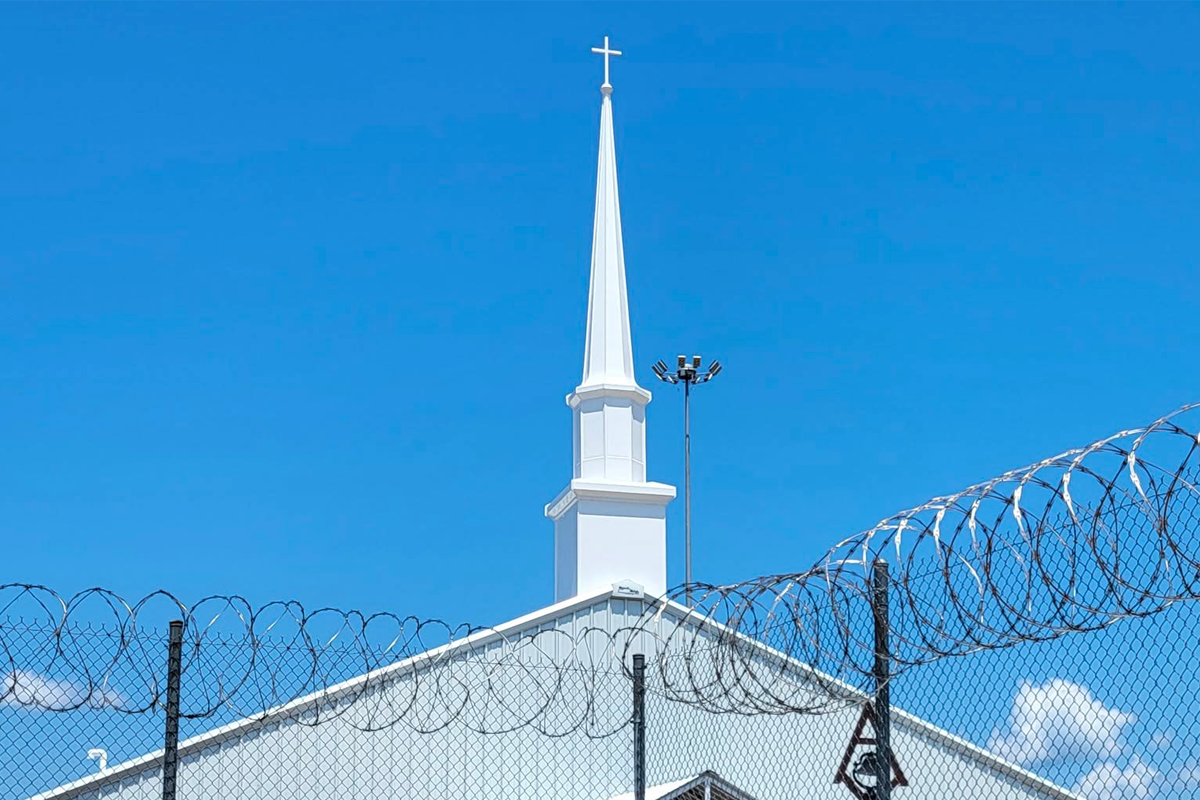
There is a difference between inter-religious encounter and inter-faith endurance, and I learned it in a chapel with a white steeple.
Inter-religious is what happens when two traditions negotiate shared space — whose symbols stay visible, whose coverings go on, whose prayer schedule takes precedence. It is necessary work. It is also, at its core, a conversation between structures. Between institutions. Between the custodians of form.
Inter-faith is something else entirely. It is what happens in the body, in the moment before and after the negotiation — when one human being makes room, genuinely and sacrificially, for another human being’s fidelity with the Divine. Inter-faith does not happen in policy memos. It happens in the hands and hearts.
I know this because of what a group of Catholic sisters did with their hands when they learned a Muslim chaplain was coming which touched my heart.
The Chapel
In 1999, I became a newly contracted prison chaplain at a state correctional institution in rural Connecticut — hidden from public view by forest, situated on state land with a beautiful lake, only a mile from Long Island Sound. My office was inside a chapel with a white steeple. Three of its interior walls bore the Stations of the Cross — fourteen markers tracing the suffering walk of Jesus toward Calvary, permanent fixtures in a space built by and for a Catholic/Protestant imagination.
As a Muslim, I was considered an outsider. And yet, before my arrival, it had been decided that this Christian chapel would be used for Muslim salat — our five daily prayer services.
The theological problem was immediate. We cannot prostrate in a room where graven images are displayed. The Stations of the Cross were not decorations. They were devotional objects, each one a stained glass depiction of a sacred story — and they covered the walls of the room where we were expected to bow our foreheads to the ground.
What happened next has stayed with me for over two decades.
The religious community of sisters who supervised the chapel attempted to cover up this tension. They picked up their knitting needles and made fabric coverings, by hand, to drape over the Stations of the Cross before each of our prayer times.
We would arrive. We would cover. We would pray. We would uncover. We would fold the coverings carefully and store them for the next time.
It was a fine and faithful routine. It was also, I now understand, an act of inter-faith — not inter-religious. Those sisters were not negotiating symbols. They were saying, with yarn and time and quiet labor: your prostration matters to God, and so it matters to us. So I thought.
What Entered the Chapel
Every time I crossed that threshold, I performed a kind of ritual I have only recently learned to name.
At the door, I set down certain things that belonged to my religion — not permanently, but provisionally. I acknowledged that I was entering a space not built for me, that the architecture itself was a confession of faith in a tradition not my own. The cross above the door was not my symbol. The Stations on the walls told a story of suffering I honor but do not claim as my own salvific narrative. To enter was to hold my own tradition lightly enough to be genuinely present in another’s.
But I carried my faith with me — all of it — although it was treated like contraband.
The certainty that God is present wherever God’s name is sincerely called. The conviction that the earth belongs to Allah, and that no building — not even a chapel — is more sacred than the act of honest prostration within it. The knowledge, rooted deep in Qur’anic soil, that Abraham was hurled into a fire by a king who believed that heat and flame were the final word on a body that had dared to question power — and that the fire became cool. That which threatens the servant of the All Powerful God does not have the final word.
What you carry in is the theological question at the heart of every interreligious encounter. Your religion will tell you what to cover. Your faith will tell you whether to stay.
When the Coverings Were Stolen
Then came September 11, 2001.
Within weeks, the climate of the institution shifted in ways I could feel in my body before I could name them. Officers who had been colleagues looked at me differently. The atmosphere thickened with what I can only describe as a collective narrowing or thorny bushes — a search for the enemy among us — and I was, by virtue of my name, my faith, my skin, the most available candidate caught in those sneers.
And someone began stealing the coverings.
We would arrive to pray and find them gone. The sisters would knit new ones. Someone would steal those too. The cycle repeated — an act of inter-faith destroyed, again and again, by an act of institutional hostility dressed as anonymity.
An earlier administrator, before the political winds shifted, had proposed what seemed like an elegant solution: “Let’s hang the Stations of the Cross on hooks,” he said. “The Muslim community can take them down before prayer and put them back up after.” Simple. Mutually respectful. Requiring nothing but a small shared willingness to hold things lightly.
The supervising chaplain rejected it immediately. Hooks, she felt, would compromise the theological integrity of the Christian chapel.
So we kept covering. And the coverings kept disappearing. The nails were the only permanence.
The Nail
When the administration finally acted, their solution was to nail the Stations of the Cross permanently to the back wall of the chapel.
I could not help but notice the quiet theological irony: images of a body being fixed in place by imperial authority were themselves now nailed down by institutional decree. They had reinforced permanence when the moment called for flexibility. For nails, when it needed hooks or humble grace.
And then we moved on — because faith does not wait for institutions to find their wisdom.
The Prayer That Moved Outside
On one particular Jum’ah morning, I arrived to find the replacement coverings had not yet arrived. The walls were bare. The Stations looked back at us.
I made a decision.
I gathered the Muslim community and led prayer on the main compound — outdoors, in the open yard, visible to everyone. Sky above us. Ground beneath us. Men bending toward Mecca while officers watched.
It turned out to be a security violation.
It also turned out to be the moment that finally forced the administration’s hand — though not in the way any of us would have chosen. What followed was not resolution so much as rupture. The supervising chaplain returned from vacation to find her chapel — as she experienced it — unsettled at best descrated at worse. A chain of retaliation followed that included things I will not detail here, except to say that among them was a childhood photograph of me — one my mother had given me to hold courage during a difficult season, a picture of myself as one of the first children to desegregate an all-White elementary school. Officers found it in my office. They painted over my face with White-Out and scribbled a racial slur above and below my head in red ink.
They were reaching, in the only way they knew how, for the nail and what felt like fire.
I requested a transfer. I never prayed in that chapel again.
What the Chapel Could Not Hold
In retrospect, the sisters understood something the institution could not sustain.
To make space for the other is not a logistical act. It is a spiritual one. The coverings they knitted were a theology — small, portable, made by hand — that said: we will not require you to choose between your faith and this space. We will make room. That is inter-faith. That is the thing that cannot be written into a policy or nailed to a wall.
What the institution offered instead was inter-religious management — the administration of symbols, the negotiation of fixtures, the maintenance of boundaries dressed as inclusion. And when that management came under pressure, it reached for the instruments of power: suspensions, surveillance, slashed tires, stolen coverings, red ink.
None of it could touch what I carried in.
Abraham was not nailed. He walked into the fire and the fire became cool — not because the king was wrong about the fire’s heat, but because what Abraham carried inside him was not made of material that flames consume. His faith was portable. His trust was his own. The fire had no jurisdiction over it.
On that Jum’ah morning in the prison yard, with no coverings and no chapel and no institutional permission, we prayed anyway. The earth was our masjid. The sky was our ceiling. The ground received our foreheads just as it always has, just as it always will.
The fire was real.
The connection to the All Powerful was realer.
And the cool — the cool came not from the institution finding its decency, but from the faith we carried in our bodies out into the open air, where no one could cover it, and no one could nail it down, and no one could take it away.
This blog was previously published here and has been republished with the author’s consent.
Bilal Ansari is Associate Professor of Practice, Co-Director of MA in Chaplaincy at Hartford International University and a former state prison chaplain. firebecool is his Substack on pastoral theology, sacred encounter, and the fire that does not consume.