
Why I do what I do at HIU: A Personal Journey
In October of 2004, my family and I were enjoying a quiet getaway on the shore of the Red Sea in Egypt. We were living in Egypt at the time and had decided to visit the seaside during a national holiday. We spent our first day having a great time at the beach. That night, however, our world was shaken.
We had just put the kids to bed when a large explosion rocked our hotel. Everything went gray. The air was filled with dust and flying glass. In shock, we carried our children out of the hotel, down ten flights of emergency exit stairs. Pulling ourselves from the rubble, we made our way out from the dust and dark into the chaos of the street. Thirty-four others were not so lucky. They did not live to see the morning. Many, many more were injured. Thankfully, none of us were seriously wounded. However, each of us has been mentally scarred. We still carry this day with us, each in our own way.
The Taba Hilton bombing was the result of a larger political and religious calamity. While there has always been debate about the motives of the perpetrators, the Egyptian government tied the terrorist acts to three Egyptians supporting the Palestinian resistance against Israeli Occupation. The bombing was not about me or my family. We were just in the wrong place at the wrong time, like so many others in so many other catastrophes around the world.
Lessons from Tragedy
When I reflect on my original emotional response to this tragedy, however, I never felt we needed to get “home” – back to the U.S. I never felt that our lives were still endangered or that we could not continue to live in Egypt. I did not feel that we were no longer safe. Certainly, there were intense moments of PTSD, but that did not affect my love for our lives and the communities in Egypt. As one colleague told me after Taba, “God has more work for you to do.” In fact, this tragedy gave me a new perspective on the work of interreligious and intercultural dialogue.
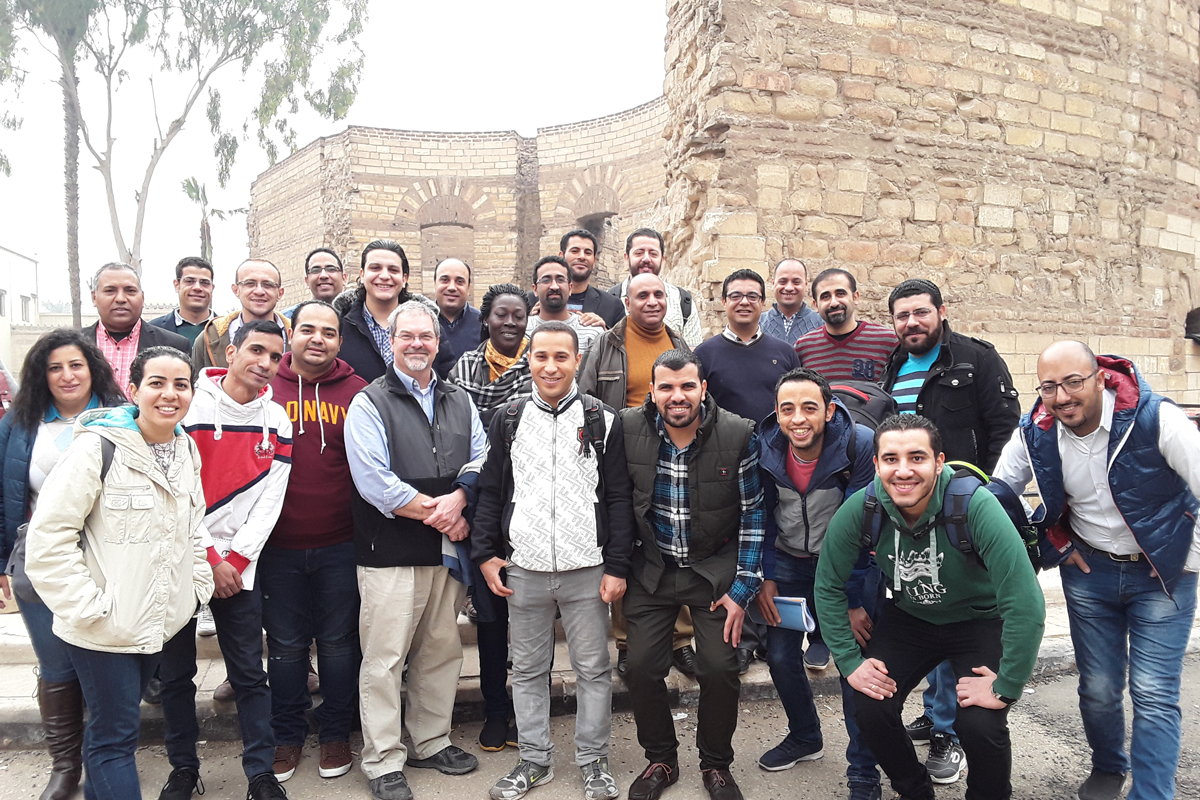
At the time, I was teaching at the Egyptian Presbyterian Seminary in Cairo and my spouse, Karla, was the foreign languages librarian. I directed the graduate school and taught Middle Eastern Christianity and Interreligious Dialogue. In addition to guiding Arab, Asian, and European graduate students, I was responsible for setting up travel programs for seminaries and colleges in the U.S. I helped them to engage in study tours on Egyptian Christianity, Christian-Muslim relations, the history of Islam in the Middle East, and of course the requisite visits to Egypt’s amazing Pharaonic history.
Importance of Intercultural and Interreligious Education in the United States
After a few more years, it became clear to us that if we were going to respond proactively and effectively to the continued political and religious violence in the world, intercultural and interreligious education was critical not only for the global community but specifically within the United States. And so we returned “home.” The turmoil has continued unabated and so has the need for interreligious and intercultural education. In fact, with the current rise of anti-immigrant and xenophobic feelings and government actions in the U.S., such education is needed domestically now more than ever.
One cannot learn about other cultures or peoples without learning about how their religion is lived out in their daily lives. Interreligious education does not force us to a least common denominator so that no one is offended by different religious beliefs. Rather, interreligious engagement has the power to deepen our own religious convictions while providing skills of appreciation for those who differ from us. I have found that curious, sincere, and critical examination of religious relationships – as people of religion – can be life giving.
Cultural and Religious Diversity Shaping Communities
I grew up in a German Lutheran community in the Midwest. Two generations prior, my family were farmers south of Detroit. By my parents’ generation, however, most of my relatives were working for the Big 3 – the ubiquitous automobile industry of Detroit. Since the early part of the twentieth century, the auto industry has brought many different kinds of people to work in the factories and the various subsidiary companies. Many of these original auto workers were Arab immigrants. They came and stayed to start a new life. They created the most diverse Arab intercultural community in the U.S. – Lebanese Maronites, Iraqi Shi’i, Chaldeans from Syria, Yemini Sunnis … all living in Detroit among Polish Catholics, Anglo Presbyterians, German Lutherans, and African American Baptists and Muslims of the Nation of Islam.
Growing up in my family and church community, I was oblivious to the cultural and religious diversity around me. I must say, this was not for my father’s lack of trying. Working on the assembly line in the factories, he experienced racial, cultural, and religious diversity and tried at times to help me see that. But, by and large, segregation was a social reality. We white Protestants and Catholics lived in Allen Park and Dearborn, and the people of other faiths and colors lived in Detroit and East Dearborn.
Once upon a time, my German immigrant ancestors were considered aliens and un-American. Benjamin Franklin did not have very kind things to say about the “swarthy Germans” who he claimed could not speak English. But by World War II, German Christians had mostly stopped worshipping and speaking in German for fear of being perceived as un-American. Americans of German ancestry – like my own – gradually became assimilated into the white dominant culture of Protestant America. That tolerance has not been afforded to brown and black communities.
In many ways, it wasn’t an accident that eventually led me to the Middle East – to Lebanon and to Egypt. It has been this curious fascination of Middle Eastern cultures – Christian and Muslim – that has driven my academic and religious professional life. I certainly am not glad to have become a victim of terrorist violence. But that event steeled my resolve that interreligious and intercultural education is a necessary antidote to address our stubborn human desires to inflict pain on one another based on cultural and religious ignorance. Knowledge and relationships are key. Ignorance leads to fear and worse.
About Hartford International University
HIU offers degree programs in Interreligious Studies and co-publishes the Journal of Interreligious Studies. Our curriculum balances scholarly analysis and reflection with the practical application of interreligious studies principles and methods, preparing students for careers in chaplaincy, peacebuilding, or community leadership where they will engage directly with people who subscribe to different traditions of belief and practice.
Rev. Dr. David D. Grafton is Professor of Islamic Studies and Christian-Muslim Relations at Hartford International University for Religion and Peace.