
Retreat Brings Chaplains’ Hearts and Minds Together
What difference can three days make in years of chaplaincy education and training?
In June, eleven students from Hartford International University’s MA in Chaplaincy program gathered for an annual retreat. They came together from Idaho, Texas, Rhode Island, North Carolina, and across Connecticut.
The retreat was framed around three core questions: Who am I? Who is God? Who are we?
These questions scaffolded the three-day gathering – with each question shaping activities to facilitate storytelling, sharing, collective growth, and reflection.
Question One: Who Am I?
Based on the Scandinavian Human Library idea, each student and faculty member prepared a “book” of their lifecomplete with a title and chapter headings.
Classmatest then “checked out” one another’s books and listened deeply to each other’s stories. The sharing was rich and powerful. In truth, we could have spent the entire retreat doing just this and still experienced deep growth through m time with classmates – sharing lives and stories, challenges, and callings. At the end of each story and sharing session, students wrote blessings for the one whose story they had heard – or for the one who had listened attentively.
Question Two: Who Is God?
Each student came prepared with a list of attributes most precious to them in describing who God is. These cherished attributes of the God they trust were written on Post-its and placed on a board.
Then, as a group, students were asked to cluster and categorize the attributes. All had to contribute, all had to agree – and they were purposely not given a prescribed process. Chaos ensued as the students pitched in. Post-its were rearranged, contested, and rethought – and then hung back to see what happened. Finally, after much discussion, they had categories they could agree on.
Although, later in the weekend, several notes were changed again, categories were re-ordered, and Post-its moved as students’ thinking deepened and they became more honest and trusting in one another. As we gathered to process the experience, we again wrote blessings – this time for the group, and for our chaos.
Theologian Terrence Fretheim wrote:
“It is not enough to say that one believes in God. What is important, finally, is the kind of God in whom one believes. Or, to use different language: metaphors matter. The images used to speak of God not only decisively determine the ways one thinks about God, they have a powerful impact on the shape of the life of the believer. The question of the kind of God in whom one believes is not only important, it is crucial. It is a question of images. Metaphors matter.”
Question Three: Who Are We?
The third question shifted the focus to the collective – on the chaplaincy group and the growing and deepening learnings that the community gathered.
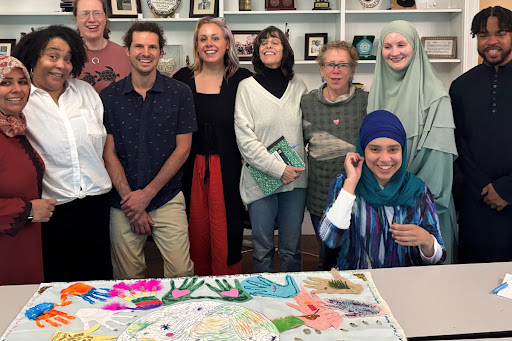
In small groups, students wrote statements connecting their chaplaincy, the theological statements to which they had agreed, to describe themselves and their chaplaincy. Then they were given a large table, a blank fabric canvas, a box of myriad art supplies, and a drawing of the Earth. First, students were instructed to create a process that involved them all, and to which they could all agree through the final creation. Then they were asked to create a work of art on the canvas that symbolized their service to the world through the placement of each of their hands in relation to the earth, as well as in relation to God, the Source of it all.
We watched a beautiful process unfold. With intention and prayerful sharing of energy, the group placed the earth in the center of the canvas. They opted for each student’s freedom to represent themselves artistically and trace their hand in ways that symbolized their r own heart and individual calling. They placed their hands in service to the earth, found the source in gold glitter peeking out at the edges of the canvas, and finally took turns writing a poem contributed by a classmate around the edges of the canvas. When they were finished, we found glitter around the room, on their faces, and in their hair. Their canvas was colorful, glittery, artistic, symbolic, and a witness to their growth.
A Community Formed Through Trust, Conflict, and Care
The process was not easy. There were disagreements and conflicts, tears, and moments of hurt, but there was also laughter, reconciliation, and deep mutual care. Twice, the group paused the activity to acknowledge and process hurt – an ouch – and restore the integrity of the community.. As we gathered in a circle to celebrate the art and the forms it had taken, we wrote blessings for the group.
As a final prayerful ritual, we enacted a red thread ceremony, drawnt from Tibetan Buddhism and also symbolic in Kabbalah and Hinduism. The red string is a cord of protection and blessing, representing the color of Asian celebration, courage, and strength. Monks tie red strings on each other’s wrists, wishing these qualities on the other.
We passed the red thread around the circle – holding it together with both hands on the string, each of us spoke a series of blessings that we had written over the weekend. We offered blessings over our gathering and our circle — for individuals, for the challenges we had faced, for moments of celebration, and for our community. At the end, we cut the thread and helped each other tie it around our wrists. Those red strings symbolize the bonds of blessings we shared through the weekend in words, experiences, growth, and blessings. Those red strings will show up again, to be sure.
A Weekend of Transformation
The retreat also ncluded a cookout near the beach, a drum circle, meditation with singing bowls, and even some board games.
Throughout the weekend, we witnessed transformation – our students grew as individuals and as a group while they shared their stories, theological and spiritual commitments, and their understanding of what they bring to the world in need.
We are confident that they will bechaplains who serve the Holy One, the Source, the hurting earth, and its people with courage and care.
Lasting Impact for The World They Will Serve
These three days gave us the privilege of seeing our students in action – , caring for each other, building networks, learning new skills, trusting themselves and each other. We hear them sharing, see them making meaning within their own spiritual parameters, and nourishing each other’s souls.
We are deeply proud of what we accomplished together in just three days and how this retreat shaped the formation of our chaplaincy students, our community, and ultimately, the world they will serve.
The collaborative canvas they created now hangs in our building. As you walk by, be careful: you might find a bit of gold glitter clinging to your clothes, your hair, or your shoes – a sparkling reminder of the Divine Source of all care, trust, and love, calling you, too, to deeper healing, community, and service. .
About the MA in Chaplaincy at Hartford International University
Hartford International University for Religion & Peace offers a Master of Arts in Chaplaincy (MAC) program designed to train the next generation of spiritual care professionals – religious leaders who view chaplaincy as the professional practice of care for all people. The program integrates theological education with psychology, sociology, and intercultural understanding to nurture chaplains who lead communities with empathy, clarity, and purpose and can offer inclusive, compassionate spiritual care in a wide range of settings – from hospitals and prisons to the military and higher education.