
Howard Thurman, Martin Luther King Jr., and Andrew Young: Three Men, One Mission
Last summer, I found myself standing in a quiet Connecticut tobacco field just outside of Hartford, guiding a drone across a vast landscape. The earth was rich, and the barns weathered by sun and time. This place serves as a living thread between three remarkable men united by a common mission.
In the summer of 1944, a young Martin Luther King Jr. worked under this same sun, harvesting tobacco alongside other students from the South. He had come north to earn money to send back to his family in Georgia.
During his time in Connecticut, King experienced something that would stay with him for the rest of his life. He attended integrated worship services in Hartford and saw people of different races walking together and occupying the same public spaces. In letters home, he described the experience as transformational.
Unbeknownst to King, 80 years later, Hartford International University for Religion and Peace would establish a new center dedicated to the legacy of his spiritual mentor, Howard Thurman, and housed in a building sponsored and named for one of his closest lieutenants in the fight for civil rights, Ambassador Andrew J. Young ’55.
Three men. One Mission.
Atlanta
My journey to the Peach State began with the realization that we needed to bring the story of HIU’s Howard Thurman Center to life through the voice of one of King’s closest companions — HIU alum Andrew J. Young.
Andrew Young is a forefather of the Civil Rights movement. Serving as Dr. King’s right-hand man, he was at his side during many of the movement’s defining moments. A pastor and diplomat, Ambassador Young served in the U.S. House of Representatives, two terms as Mayor of Atlanta, a city he helped transform into a global hub for business and culture, and as the U.S. ambassador to the United Nations under President Jimmy Carter. As my Uber made its way from the airport to the city, I glanced out the window just as we passed an exit sign that read Andrew Young Intl Blvd. I instantly felt a wave of intimidation and weight.
The Andrew Young Foundation
It says something when the least remarkable feature in someone’s office is a row of Emmy awards displayed in a glass case. The walls of Ambassador Young’s foundation office were lined with photographs capturing decades of indelible and historic moments. In the age of AI image and video generation it’s almost easy to glance past imagery like this without fully absorbing its impact. Yet every photo carries an emotional and historical context that cannot be replicated or rendered. It’s why I remain optimistic about artistry over automation.
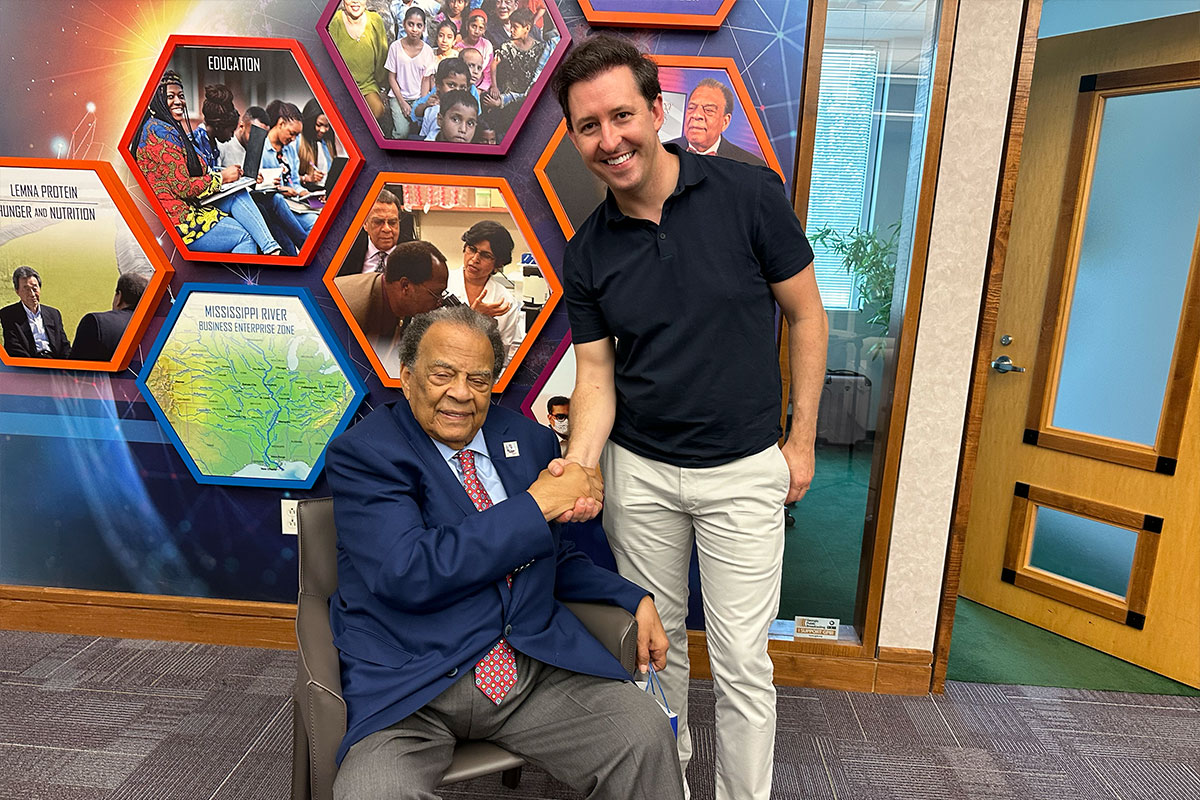
At ninety-two years old, Ambassador Young was relentless. He had three interviews scheduled that day, with mine being the second. As he emerged from his office, any preconceptions I had about meeting a historical figure disappeared instantly. He greeted me with a warm smile and firm handshake.
What was intended to be a twenty-minute session turned into more than an hour as we recorded his portion of the video and spoke at length about his life. He shared stories of his time alongside Dr. King, his own family and the 1996 Olympic games, for which he served as co-chair. He told me he was up late the night before watching the Summer Games in Paris and couldn’t believe the talent of the U.S. women’s gymnastics team. The conversation then steered to his latest passion project, aquaponics sustainable farming, a practice that pairs aquaculture with hydroponics — the practice of growing plants without soil. The cutting-edge initiative is meant to address world hunger, sustainable development and socially uplift underserved communities. As our session ended, I thanked him for his time and generosity, he simply replied, “This is what my time is for. I’m meant to do this.”
Hartford
Back in Hartford, as the video piece came together, I kept thinking about the three men whose legacies converge in this project. Each from a different background, each confronting their own challenges. Yet all shared the same conviction: faith must be lived through action.
Howard Thurman, a theologian and mystic, laid the spiritual foundation for the Civil Rights Movement. His teachings on inner freedom and the dignity of every human being deeply shaped King’s philosophy of nonviolence and continue to guide and inspire our educators at HIU. King carried those ideas into the streets, transforming spiritual truth into social change. Andrew Young, who studied at HIU (formerly Hartford Seminary) before walking beside King, carried that mission forward through diplomacy, leadership, and a lifelong pursuit of justice.
In September 2024, that lineage came full circle as Hartford International University hosted a special event to raise funds for a building named after Ambassador Young that will, after renovations, house the Howard Thurman Center for Justice and Transformational Ministry. The celebration marked the renewal of an enduring mission — to educate leaders who transform faith into service and difference into understanding.
The legacies of Thurman, King, and Young remind us that peace is not passive and justice is never finished, it’s a relentless mission. Their work continues here, at Hartford International University, where the call to lead with conscience, compassion, and courage remains as urgent as ever.
The video, Andrew Young Presents The Howard Thurman Center, received First Place in the State of Connecticut for video production and went on to win top national honors from the National Federation of Press Women in 2025. Watch Here.
For an in-depth look into the life of Ambassador Andrew Young, watch the MSNBC documentary “Andrew Young: The Dirty Work,” which first aired on Oct. 17, 2025. Find it here.